Nearshore Mexico Expansion: The Complete Guide for B2B Tech Companies
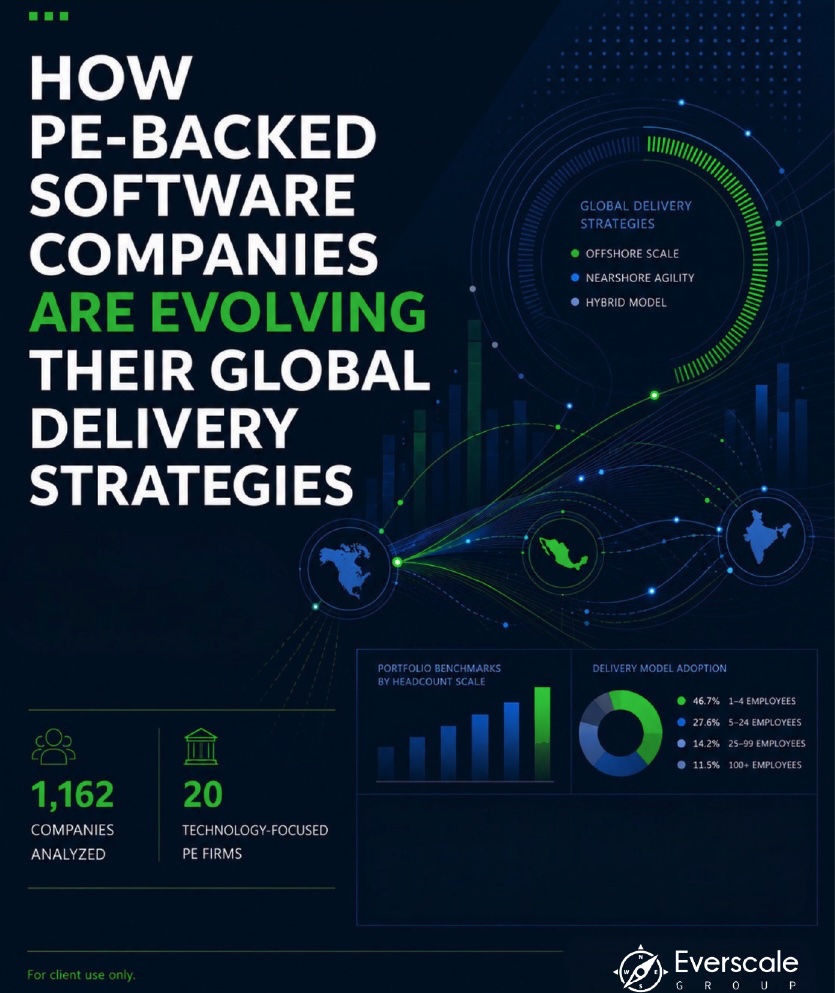
Everything a COO, CPO, or Head of Operations needs to evaluate Mexico as a nearshore option: the expansion models, the cities, the real cost structure, and the timeline from decision to a productive team. 84% of PE-backed enterprise software companies already run foreign delivery operations. This guide is about building one that fits how B2B tech actually scales.
Get a financial comparison for your specific team size, role mix, and city, before you commit to anything.
Book a Discovery Call35+ years operating in Mexico · 25,000+ employees
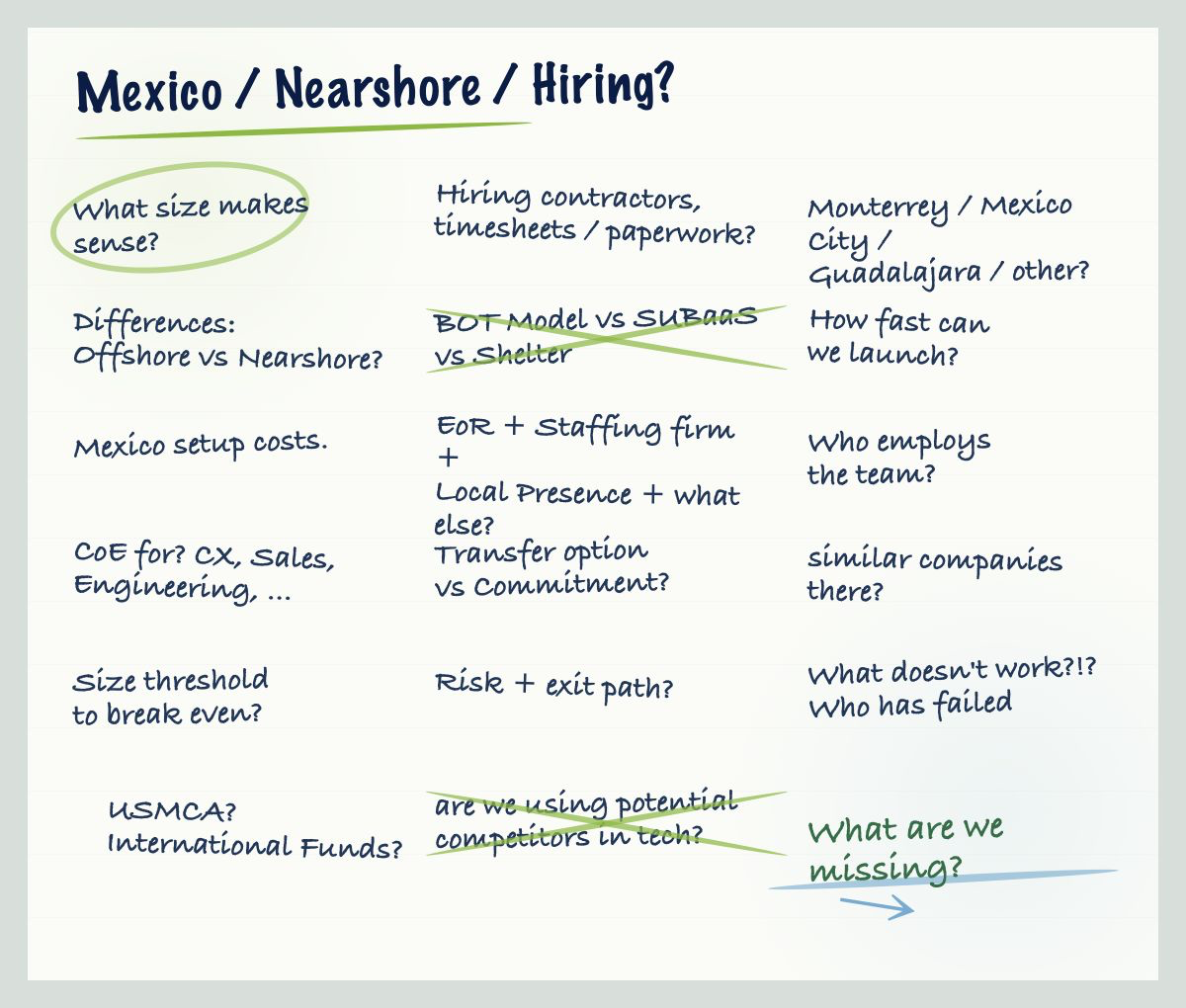
Mexico is not an offshore play. It is a nearshore play. The operating logic is different: smaller teams, US-timezone overlap, proximity-driven collaboration, and a cost structure that works at 10 people, not just at 200. For B2B tech companies, that changes what is possible.
This guide follows the path a COO, CPO, or Head of Operations actually walks when evaluating Mexico, starting with the decision that governs every number that comes after it, then moving through talent, cost, timeline, and compliance in the order they matter. Each section builds on the one before it; read in sequence, it is a single argument, not a menu.
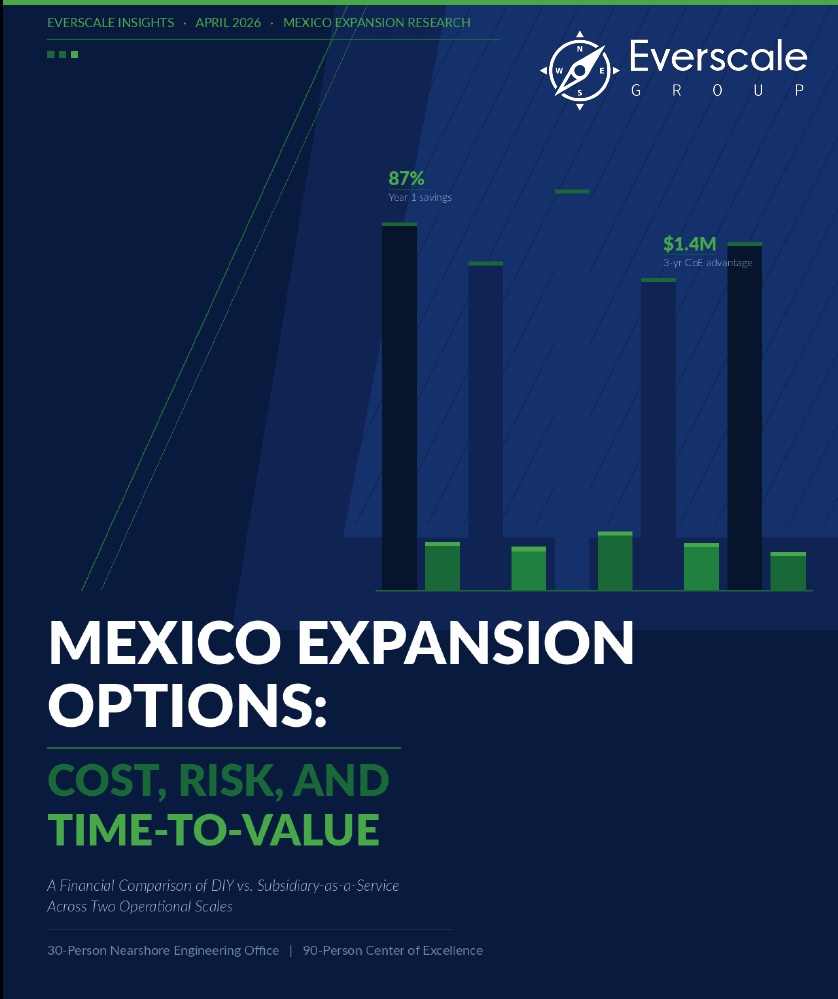
For the financial model behind this guide, download the Mexico Expansion Financial Analysis, a 3-year comparison of DIY vs. SUBaaS across two operational scales.
Where the decision startsWhy B2B Tech Companies Are Building in Mexico Now
Three structural shifts are accelerating Mexico nearshore adoption in the enterprise software sector, and each one points toward the same conclusion: the model that worked for India does not automatically transfer.
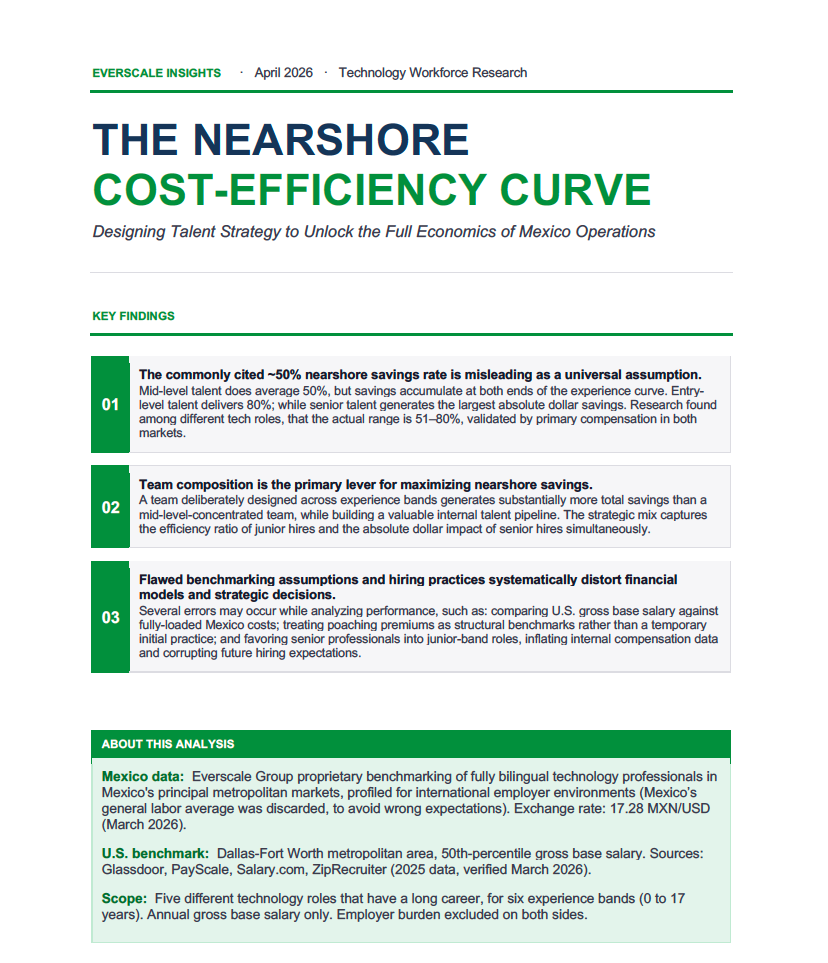
The first is cost. Engineer-level talent in Mexico's principal metro markets costs 40–65% less than equivalent US talent, depending on role and experience band. That gap is well-documented. What is less understood is that the savings range is wider than the commonly cited 50% average, entry-level talent delivers closer to 80% savings, while senior talent generates larger absolute dollar savings even at a lower percentage. Team composition is the variable most companies fail to model, and it is the one we return to once the operating model is settled.
The second is proximity. Same-day travel from most US hubs. One to two time zone difference at most. The collaboration model for a Mexico team looks like a distributed US team, not an offshore center that operates while headquarters sleeps.
The third is flexibility. The average Mexico office for a PE-backed enterprise software company is 25 employees. India averages 186. Mexico was never designed for large fixed-capacity centers, it was designed for agile, right-sized operations that can start lean and scale without overbuilding. In an environment where AI is reshaping headcount assumptions, that flexibility has become a strategic advantage, not just a cost play.
The Three Mexico Expansion Models
Those three shifts make the case for Mexico. They do not tell you how to structure it, and that structural choice governs every number in the rest of this guide.
Before modeling talent cost, headcount, or timeline, the operating model decision has to come first. The model determines the overhead structure, the risk exposure, and the implementation speed. An optimally staffed team running under the wrong model will systematically underperform its savings potential. There are three models available, and the rest of this section defines each before we measure them.
DIY, Stand-Alone Entity
The company incorporates in Mexico, opens a local bank account, hires administrative staff, and manages all legal, HR, payroll, tax, and compliance obligations independently. Full ownership and control from day one, but the full administrative infrastructure cost falls on the company.
For a 30-person team, administrative overhead under DIY consumes 52% of total Mexico center costs in Year 1. That number does not scale down with headcount. It is structural drag that compounds with every month the operation runs below its efficient scale, a point that becomes decisive when we reach the overhead and shutdown numbers.
EOR, Employer of Record
A third party legally employs the workers on the company's behalf, handling payroll and compliance. The company directs the work but does not own the entity. Lower setup friction than DIY, but the company also does not build operational infrastructure it can scale, and the EOR fee structure typically assumes individual contractors or small teams, not a 30–90-person center operating under the company's brand.
Where EOR breaks down at scale
EOR is an excellent instrument for what it was designed to do: employ a handful of people in a country where you have no entity, fast. The problem is that companies adopt it as a starting point for a growing operation, and the model was never built for that trajectory.
The per-head economics invert as you grow
EOR pricing is typically a flat fee or percentage per employee. At 3–5 people that is cheap relative to standing up infrastructure. At 30–90 people, you are paying a per-head premium every month on every employee, indefinitely, for a service whose cost to deliver does not rise the way your bill does. There is no point at which the model rewards your scale, the economics work against you precisely as the team gets large enough to matter.
You build nothing you can keep
Under EOR, the entity, the payroll relationship, and the compliance footprint all belong to the provider. If you outgrow the model and want to convert to your own subsidiary, you are effectively starting the DIY timeline from zero, re-papering every employment relationship, migrating payroll, and absorbing the 4–6 month setup you thought you had avoided. The early speed becomes a future migration cost.
Brand and control dilution
Employees are legally employed by the EOR, not by your company. For a back-office contractor that is invisible. For a 40-person engineering center you are trying to build culture, retention, and an employer brand around, having every offer letter, badge, and payslip carry a third party's name is a real friction on identity and loyalty.
Self-service tickets instead of an account team
Most volume EOR platforms are exactly that, platforms. Support runs through a ticketing queue and a self-help knowledge base. When a payroll discrepancy, a termination, or a compliance question lands, you open a ticket and wait in line behind every other customer. There is no named account manager who knows your operation, no one accountable for an outcome rather than a response-time SLA. For a company running a material team in an unfamiliar regulatory environment, "log a ticket" is not an operating model, it is exposure. The as-a-Service model is the opposite by design: a hands-on account team that owns your operation's health, not a help desk you escalate into.
The throughline: EOR optimizes for entry, not for scale. The moment future growth is part of the plan, its limitations stop being inconveniences and start being inherited risk.
SUBaaS, Subsidiary-as-a-Service
The client operates under the vendor's existing legal, HR, payroll, and facilities infrastructure, paying per employee on a tiered fee structure. The operation runs under the client's brand from day one. The client retains full operational ownership and management control. The vendor provides the shared infrastructure layer.
This is the IT industry's adaptation of the Shelter Model that transformed manufacturing in Mexico for the past 30 years, applied to software, SaaS, and IT services delivery. The result is a shared-infrastructure model analogous to cloud computing: enterprise-grade operational capability without building or owning the underlying infrastructure.
Under SUBaaS, administrative overhead holds below 13% across all three years, regardless of team size. A productive team can be operational in 30–45 days.
| DIY | EOR | SUBaaS | |
|---|---|---|---|
| Setup timeline | 4–6 months | 2–4 weeks | 2–4 weeks |
| Year 1 overhead % | 41–52% of total cost | Variable per-head fee | 8–13% of total cost |
| Brand ownership | ✓ Full | ✗ Limited | ✓ Full |
| Operational control | ✓ Full | ✗ Directed only | ✓ Full |
| Shutdown cost (30-person, Y1) | $512K | Lower | $86K (83% reduction) |
| Best fit | Large teams, long horizon | Individual contractors | B2B tech, PE-backed, 10–200 people |
The model comparison summarized here is the subject of a dedicated companion guide. For the full side-by-side across cost, overhead, shutdown, and speed, see SUBaaS vs EOR vs DIY: Mexico Expansion Models Compared, or download the Mexico Expansion Cost, Risk, and Time-to-Value Analysis.
Decision two, only valid once the model is setMexico Talent: Cities, Roles, and Cost Bands
With the model decided, the cost structure is locked, so the talent questions that follow finally produce reliable numbers instead of estimates resting on the wrong overhead base.
Mexico has four principal tech talent markets. Each has a different profile, cost structure, talent pool depth, time zone positioning, and typical use case.
| City | Strongest For | Time Zone | Cost Profile |
|---|---|---|---|
| Monterrey | Client-facing, operations, bilingual senior roles | CT, US overlap | Mid-high |
| Guadalajara | SaaS delivery, engineering, DevOps, QA | CT, US overlap | Mid |
| Mexico City | Enterprise software, professional services, finance | CT, US overlap | Mid-high |
| Tijuana / Hermosillo | US PT-timezone roles, bilingual tech support, cost-efficient engineering | PT, full US West overlap | Lower |
Roles B2B Tech Companies Build in Mexico
The roles most commonly built in Mexico cluster into a recognizable set:
- Software engineers (full stack, backend, frontend, mobile)
- QA engineers and DevOps
- Cloud architects and infrastructure
- Product managers and product operations
- Implementation consultants and delivery managers
- Customer success and technical support
- Data engineers and BI consultants
- SAP and ERP delivery specialists
But roles are not hired in isolation, they are assembled into business units. And the unit a company stands up first is rarely a staffing accident. It is a signal of the underlying strategy.
The Business Units Built First, and What They Reveal
Across B2B tech expansions, the same handful of units tend to come first, each one the natural starting point for a different strategic intent. Expand any unit for why it leads, the benefit it delivers, and where it tends to land.
Technical Support and Customer SuccessThe most common first unit, because it carries clear, measurable SLAs and proves the operation can deliver quality before larger bets are placed.
Why it leads
Support and success work is governed by metrics a leadership team already trusts: response time, resolution rate, CSAT, first contact resolution. That makes it the lowest risk way to validate a new operation. Within a single quarter you have hard evidence the team can hold a quality bar, which is the proof point that unlocks budget for the larger, harder to measure units that follow.
The benefit
Beyond the cost saving on each seat, this unit de risks everything after it. It establishes the recruiting pipeline, the onboarding rhythm, and the management layer that later units inherit. You are not just standing up a support desk, you are building the operational muscle the rest of the center will run on.
Where it lands
Support and success run on US overlapping shifts, which makes Monterrey and Tijuana natural homes, Monterrey for bilingual senior support and client facing roles, Tijuana for US Pacific timezone coverage at a lower cost band. This is typically the opening move in the nearshore delivery play.
Engineering and Product DeliveryThe unit SaaS companies lead with when the goal is capacity and velocity, drawing on Guadalajara's engineering depth.
Why it leads
For a SaaS company the binding constraint is usually engineering throughput, not headcount cost in isolation. When the roadmap is bigger than the team can ship, a nearshore engineering unit adds capacity at US overlapping hours without US loaded cost. The work integrates directly into existing sprints, standups, and code review, so it functions as an extension of the product org rather than a separate offshore center.
The benefit
Velocity per dollar. The same roadmap ships faster, or a larger roadmap becomes feasible, at a loaded cost 51 to 65 percent below US equivalent for senior and staff engineers. For a PE backed company that pulls the product, and the revenue tied to it, forward in the hold period.
Where it lands
Guadalajara anchors this unit for its engineering depth and DevOps talent pool. It is usually built around a senior anchor hire who sets architectural standards before mid level scale arrives, which is exactly where the phased approach further down this page matters most.
Implementation and Professional ServicesThe unit IT service providers and ERP implementers build first, because billable delivery capacity converts directly to margin.
Why it leads
For a services business, delivery headcount is revenue capacity. Every consultant, implementer, or delivery manager added is billable, so the unit is not a cost center to justify, it is a margin engine to expand. Building it in Mexico widens the spread between bill rate and delivery cost on every project.
The benefit
Margin expansion that compounds with utilization. A consultant billed at a US rate but delivered at 40 to 65 percent lower cost improves project economics immediately, and the effect scales with every additional billable head. For ERP and SI firms running on utilization math, this is the single highest leverage unit to nearshore first.
Where it lands
Implementation and delivery talent draws on Monterrey and Mexico City for senior consultants and SAP or ERP delivery specialists, with strong bilingual client facing capability where the engagements require it. This is the natural opener for the ERP and systems integrator audience.
Sales Support and Client Facing OperationsThe unit that signals a company is using Mexico not only to build, but to sell.
Why it leads
When a company builds this unit early it is treating Mexico as a commercial market in its own right, not only a delivery base. The unit spans pre sales engineering, sales development, and account management, and its presence is the tell that the strategy is market entry, not just cost arbitrage.
The benefit
Bilingual client facing talent lets a company sell and serve in Spanish and English across Mexican and US Hispanic accounts, carrying quota and renewal targets rather than sprint velocity. It is also the bridge into the LATAM point of entry play, because the commercial muscle built here is what gets replicated into the next market.
Where it lands
Monterrey leads for bilingual senior client facing talent, which is why it tends to anchor both the Mexican market entry and the regional expansion strategies covered next.
Which unit you build first depends on why you are in Mexico in the first place. Three distinct strategies drive most B2B tech expansions, and each one changes the role mix, the city, and the sequence. Expand any play for a worked example.
Three Strategic Plays, and the Role Mix Each Requires
Nearshore Delivery for the US MarketThe most common play, Mexico as a cost efficient, same timezone extension of US operations, weighted toward engineering, QA, DevOps, and technical support.
The team builds and supports products sold in the United States, so proximity is the whole point, same day travel and full US hours overlap. This is the nearshore operation for the US in its purest form.
Worked example
A PE backed SaaS company running lean after a recent round needs to ship faster without adding US headcount at US cost. It stands up a 20 person engineering and QA unit in Guadalajara on US Central hours. The team is an extension of the existing product org, same sprints, same standups, same Slack, at a 60 percent lower loaded cost. The objective is throughput and runway, not market presence. Success metric: velocity per dollar.
Client Facing Roles to Enter the Mexican MarketHere Mexico is not just a delivery base, it is a market, with the role mix shifting toward bilingual client facing talent.
Account management, customer success, pre sales, and local sales support, with Monterrey often leading for its bilingual senior talent pool. The team is built to win and serve Mexican customers, not only to serve customers elsewhere.
Worked example
An enterprise software vendor with a growing pipeline of Mexican and US Hispanic accounts builds a bilingual unit in Monterrey, pre sales engineers, account managers, and customer success reps who can sell and serve in Spanish and English. Here Mexico is a revenue market, not just a delivery base. The team carries quota and renewal targets, not sprint velocity. Success metric: bookings and net retention in region.
Mexico as the Point of Entry to LATAMFor companies with regional ambition, Mexico is the bridgehead, and the first unit is built to be replicable.
A model that can be cloned into other Latin American markets once proven. This is LATAM market entry via Mexico, and it tends to start with a lean, leadership heavy unit designed to standardize before it scales across the region.
Worked example
A scale up with regional ambitions uses Mexico as the bridgehead for a broader Latin America rollout. The first unit is deliberately leadership heavy and process focused, built to be documented, standardized, and then replicated into Colombia, Chile, or Brazil once proven. The point is repeatability, so the early investment goes into playbooks and management depth rather than raw headcount. Success metric: time to replicate the model in market two.
The strategy you are running determines the role mix you choose, and that role mix feeds directly into the savings math below, because the experience bands you staff are themselves a function of which play you are making.
Decision two, continued, the composition leverThe Savings Range, What the 50% Benchmark Misses
Knowing which roles you will hire and where is what makes the savings question answerable, because the savings rate is not a single number, it moves with the experience band you staff.
The commonly cited 50–60% nearshore savings rate describes mid-level talent only. Everscale Group's proprietary benchmarking across Mexico's principal markets shows the actual range is 51–80% depending on experience band:
| Experience Band | Annual Savings % | Absolute Savings per Hire |
|---|---|---|
| Entry level (0 yrs) | 80% | $62K/year |
| Junior (1–3 yrs) | 68% | $58K/year |
| Mid-level (4–6 yrs) | 64% | $68K/year |
| Senior (7–9 yrs) | 57% | $69K/year |
| Staff/Lead (10–12 yrs) | 55% | $81K/year |
| Principal (13–17 yrs) | 51% | $84K/year |
Team composition, not just headcount, is the primary lever for maximizing nearshore savings, which is why the hiring sequence, not only the hiring count, determines the return.
How to read the savings range
Percentage and absolute dollars pull in opposite directions
The instinct is to chase the highest savings percentage, which points you toward junior hires at 68–80%. But the percentage is calculated against a smaller US baseline. A principal engineer saves only 51%, yet because the US baseline is $165K, that 51% is $84K in real dollars, more than the 68% saved on an $86K junior. If your goal is maximizing absolute cash savings, senior hires win. If your goal is maximizing the savings rate on paper, junior hires win. Most companies want the former and accidentally optimize for the latter.
Why the 50% benchmark is misleading
The widely quoted "50% nearshore savings" figure describes one band, mid-level talent, and then gets applied to entire teams as if it were uniform. It is not. Modeling a 30-person team at a flat 50% can understate or overstate the real number by hundreds of thousands of dollars depending on the actual seniority mix. The range that matters is 51–80%, and where you land inside it is a function of the team you design.
The composition lever
This is why the strategic play and the savings math are linked. A nearshore-delivery engineering unit skews senior and lands lower on percentage but higher on absolute dollars. A support unit skews junior and lands higher on percentage. Neither is "better", they optimize different objectives, and the right answer depends on the play you identified earlier.
Implementation Timeline: Decision to Productive Team
The model set your overhead; the role mix set your savings. The same model choice now sets your speed, and speed is the dimension most pre-entry models underestimate.
Every month an operation is not yet running is a month of EBITDA that cannot be recovered.
| Milestone | DIY | SUBaaS |
|---|---|---|
| Legal entity / infrastructure ready | ~Month 2 | Week 1 (already in place) |
| Bank account / government authorizations | ~Month 2–3 | Week 1 |
| Compliance & accounting systems | ~Month 3–4 | Not required |
| First administrative hires onboarded | ~Month 4–5 | Not required |
| First engineering hire productive | ~Month 5–6 | Week 2–4 |
| Total time to productive operation | ~6+ months | 30–45 days |
Under the as-a-Service model, the institutional knowledge comes pre-loaded. Current benchmarking data, operational playbooks, and learnings from comparable expansions by industry and scale, all of this shortens the planning phase before deployment begins.
Why the timeline gap is bigger than it looks
The DIY months are sequential, not parallel
The 4–6 month DIY timeline is not padding. Each step gates the next: you cannot open a bank account before the entity is registered, cannot run payroll before the account exists, cannot onboard your first engineer before payroll and compliance systems are live. The dependencies are linear, so delays compound rather than absorb. A two-week slip in entity registration pushes everything behind it.
Time-to-value is an EBITDA line, not an ops detail
Every month the operation is not producing is a month of output you do not get back. For a 30-person engineering team, the difference between productive in 45 days versus 6 months is roughly four and a half months of full-team output, at the loaded cost you are already carrying in planning and overhead. Under a PE thesis with a defined hold period, that head start moves the EBITDA curve forward, which is the number that actually gets modeled at exit.
What "pre-loaded" removes
Under the as-a-Service model the legal entity, banking, payroll, compliance systems, and facilities already exist. The only remaining variable is recruiting speed, which is why a productive team lands in 30–45 days instead of 180. You are not building the runway and the plane at the same time; the runway is already there.
What to Build First: The Phased Approach
Once the team can be productive in weeks rather than months, the question shifts from when you can hire to the order you should, and sequence is where the savings model from earlier either compounds or leaks.
The most effective Mexico operations follow a phased talent architecture rather than hiring all roles simultaneously.
Phase 1, Foundation
Start with senior leaders who set standards and de-risk execution. This includes selective poaching from high-performing regional companies to establish quality benchmarks.
Phase 2, Scale
As the operation stabilizes, introduce mid-level talent to scale delivery capacity. Hiring only mid-level talent in Phase 1 forfeits the efficiency gains available from the senior anchor hire.
Phase 3, Pipeline
Junior hires build the internal talent pipeline that reduces future acquisition cost and senior hiring dependency. This phase compounds savings only if Phases 1 and 2 were sequenced correctly.
This approach is often mirrored at the functional level, first a customer support unit, then sales support, then an engineering practice as the operation builds internal capability.
Why sequence beats speed when building the team
The senior anchor is what makes the rest work
The temptation under cost pressure is to fill seats with mid-level talent immediately, it looks efficient on a spreadsheet. But without a senior anchor setting standards, code review discipline, and hiring bar, the mid-level layer has nothing to calibrate against. Quality drifts, rework climbs, and the savings you modeled erode in defect cost. The senior hire in Phase 1 is not overhead; it is the multiplier on everyone hired after.
Phase 2 scales only what Phase 1 made stable
Mid-level talent added in Phase 2 inherits the standards, playbooks, and review culture the anchor established. Add them too early and they inherit nothing, you are scaling an unproven operation. The stability gate between Phase 1 and Phase 2 is the difference between scaling a working system and amplifying a broken one.
Phase 3 compounds, or doesn't
Junior hires in Phase 3 build the internal pipeline that lowers future acquisition cost and reduces senior-hire dependency. But this only compounds if Phases 1 and 2 were sequenced correctly, juniors learn from the mid-level layer, who learned from the anchor. Skip the sequence and Phase 3 produces juniors with no one to learn from, which defeats the entire purpose of the pipeline.
The principle: the savings model from the previous section only materializes if the team is built in the right order. Composition sets the ceiling; sequence determines whether you reach it.
Compliance and Payroll: What the Mexico Operating Model Requires
Every phase above runs on a compliance foundation, and whether your team carries that weight or the model carries it for you traces straight back to the first decision in this guide.
Mexico's Federal Labor Law (Ley Federal del Trabajo) governs all employment relationships. Key employer obligations include:
- Monthly payroll in Mexican pesos, calculated on gross monthly salary
- Mandatory employer contributions: IMSS (social security), INFONAVIT (housing fund), SAR (retirement)
- Annual Christmas bonus (Aguinaldo): minimum 15 days' salary, paid before December 20
- Profit sharing (PTU): 10% of annual pre-tax profits distributed to employees by May 31
- Severance obligations: constitutionally mandated, calculated on seniority and salary
Under a DIY stand-alone entity, the company manages all of these obligations directly. Under the as-a-Service model, the partner handles payroll, IMSS registration, profit sharing calculations, and all compliance reporting, eliminating the need for an in-house Mexico HR and finance function.
Everscale Group has operated Mexico payroll and HR infrastructure for more than 35 years across 25,000+ employees in the region.
Related Reading
- Soft Landing Options in Mexico: How They Work and Lessons Learned
- Mexico, Best of Two Worlds: Largest Talent Pool and Cost Efficiency
- How Tech Firms & Investors Scale in Mexico, A Roadmap for Success
- How Tech Companies Are Opening Operations in Mexico While Avoiding Costs
- SUBaaS vs EOR vs DIY: Mexico Expansion Models Compared
Ready to Build Your Mexico Operation?
Everscale Group has operated Mexico expansion infrastructure for more than 35 years. We model your specific scenario, team size, role mix, city, and growth plan, and give you a financial comparison before you commit to anything.
Book a Discovery CallOr download the Mexico Expansion Financial Analysis, a full 3-year cost model for a 30-person and 90-person team.