
Open a no risk, low-cost Nearshore Operation in Mexico

Start a temporary or permanent operation, validate talent and costs, and scale accordingly. Add Nearshore capabilities from Mexico in days and benefit from the same travel distances as other US cities.
Implement your Project-based or long-term strategy, start with 1 temporary worker, or build a 300-employee Center of Excellence.
Review custom nearshore scenarios
The Nearshore Opportunity
According to Gartner, the use of nearshore countries in the Americas has had consistent growth because of the need to balance APAC-based sourcing and same-time-zone efforts needed for Business-Critical Applications and methodologies that demand closer collaboration.

Mexico strategic location is the preferred option for North America, becoming the top trading partner for the USA. Share 1,959 miles of land border and benefits from the USMCA North America Trade Agreement (IP Protection, Working Visas, etc).
Postpandemic, Supply Chains moved to geographical hubs, and according to McKinsey’s Workforce 2020 study, found that companies that were leveraging Remote Work were benefiting from using hybrid teams in the same time zone. Forrester, found in a 2022 study, that two-thirds of decision-makers will make their most important location increases onshore and nearshore, not offshore.
How it works
Tech companies can add Nearshore Operational Capabilities in days to take advantage of Mexico’s lower cost of living and proximity. Similar to the successful Shelter Model in the Manufacturing Industry, foreign companies from the IT Industry have the Subsidiary-as-a-Service (SUBaaS) option.
It enables them to add Mexico’s operational capabilities in the size and configuration that matches their business strategy. It avoids unnecessary expenses and risks, while lowering dramatically total costs, with total ownership from day one.
It resembles the as-a-Service model, as companies pay only for users (workers) they use, benefiting from shared infrastructure. Economies of scale from the vendor further lower costs and provides a faster time to market. Another similarity is starting in weeks and not months, including the option of scaling in size and functionality when needed, not before.
Common Scenarios
- Temporary Projects/Assignments: For companies that are not ready to establish a permanent operation in Mexico but require to have nearshore capabilities in their service portfolio. The size of their team will vary, from zero to many temporary position in different periods of time.
- Software Product Team: A nearshore engineering team will have leadership positions, working as an extension of their U.S.A. organization. Office setup is a shared workspace, with senior engineers working mostly offsite.
- Regional AMS/Helpdesk: Bilingual (English/Spanish) local team supporting regional helpdesk tickets, working in conjunction with their Global AMS Center. It can scale as a Regional Office or Center of Excellence.
- Center of Excellence: Large team delivering services in the region, with offices with their own branding. It can scale in size, cities, and office space, hiring recent grads or relocating foreign employees.
All scenarios can scale in size, cities, hiring type, and offices as needed.
Because of Everscale industry expertise in the Enterprise Software Ecosystem, the turnkey subsidiary incorporates best practices and built in capabilities that will assists foreign companies in bypassing the initial learning curve and enhance the likelihood of success of local strategies. Accessing a vetted talent pool, for rapid response.
Customer Examples
Nearshore Delivery Practice
Tech Company headquartered in Seattle, WA, faced a limited and expensive market for IT Talent, including Data Scientists, Cloud Architects, and A.I. Engineers. Exploring options to open their own Mexico company.
Started their own nearshore operation using the SUBaaS approach, starting with a temporary team to avoid setup costs and risks. This helped them to pilot the region first, testing Talent and Cost assumptions, then switched to a permanent operation and started to scale accordingly.
View this case ->
Nearshore Delivery Practice
A West Coast business and technology consulting firm that supports large customers in their digital transformation journey, including advanced analytics.
Challenge: Their services require specialized talent which they struggle to hire in a limited talent pool that has become more expensive. Other Tech companies have increased their hiring radius growing in nearby countries. Evaluated different countries before selecting Mexico.
Solution
Opening a Subsidiary-as-a-Service allows them to hire top talent as employees and lets them pilot the region first, test assumptions, and continue to scale as needed.
Key takeaways
- It helped them save on initial costs and allowed them to begin with temporary offices and then migrate to a more permanent fixture.
- Overnight they had an HR department to offer attractive compensation packages without overpaying. This department is on-demand, for additional savings.
- Avoided the struggle of hiring top talent as an unknown brand and were able to recruit in different cities.
Nearshore Projects
North America SAP Partner provides ERP implementation projects, Public Cloud Services, and managed services.
Competes with global firms that offer Nearshore Pricing and Services. Ideal scenario would be to have teams when needed and commit when the volume justifies.
Opened their own nearshore operation with enough time to submit RFP and deliver proposals, opening a team with local presence after securing the projects.
View this case ->
Adding a Nearshore Delivery Practice
Midsize SAP Partner from the Midwest provides SAP implementation projects, public cloud services, and managed services.
Challenge: It was becoming ever more complicated for to compete against global firms that also offer nearshoring options, that allows them to provide lower costs with nearby teams that can be onsite when needed.
Solution
Opened operations in Mexico using a Subsidiary as a service. It was able to have full operational capabilities in a short time span that allowed them to compete for projects and win. It was a better option than opening their own operations as they didn’t have the volume or certainty to commit permanently to the region.
Key takeaways
- Avoided setup costs and unnecessary monthly expenses.
- Can scale their team up and down without the expenses of having a fixed structure
- On-demand local staff that is part of their organization, from a procurement team for local savings, to access to a vetted talent pool.
Demand certainty when expanding to a new country

Recommended cities for Nearshore Delivery
With a population of 130 Million, Mexico has a clear advantage over other LATAM Countries that attract foreign investment, such as Costa Rica (5M) and Panama (4M), with cities larger than other countries.
Guadalajara
Start-up’s and Tech hub Capital and also as the Mexican Silicon Valley.
Fact sheet
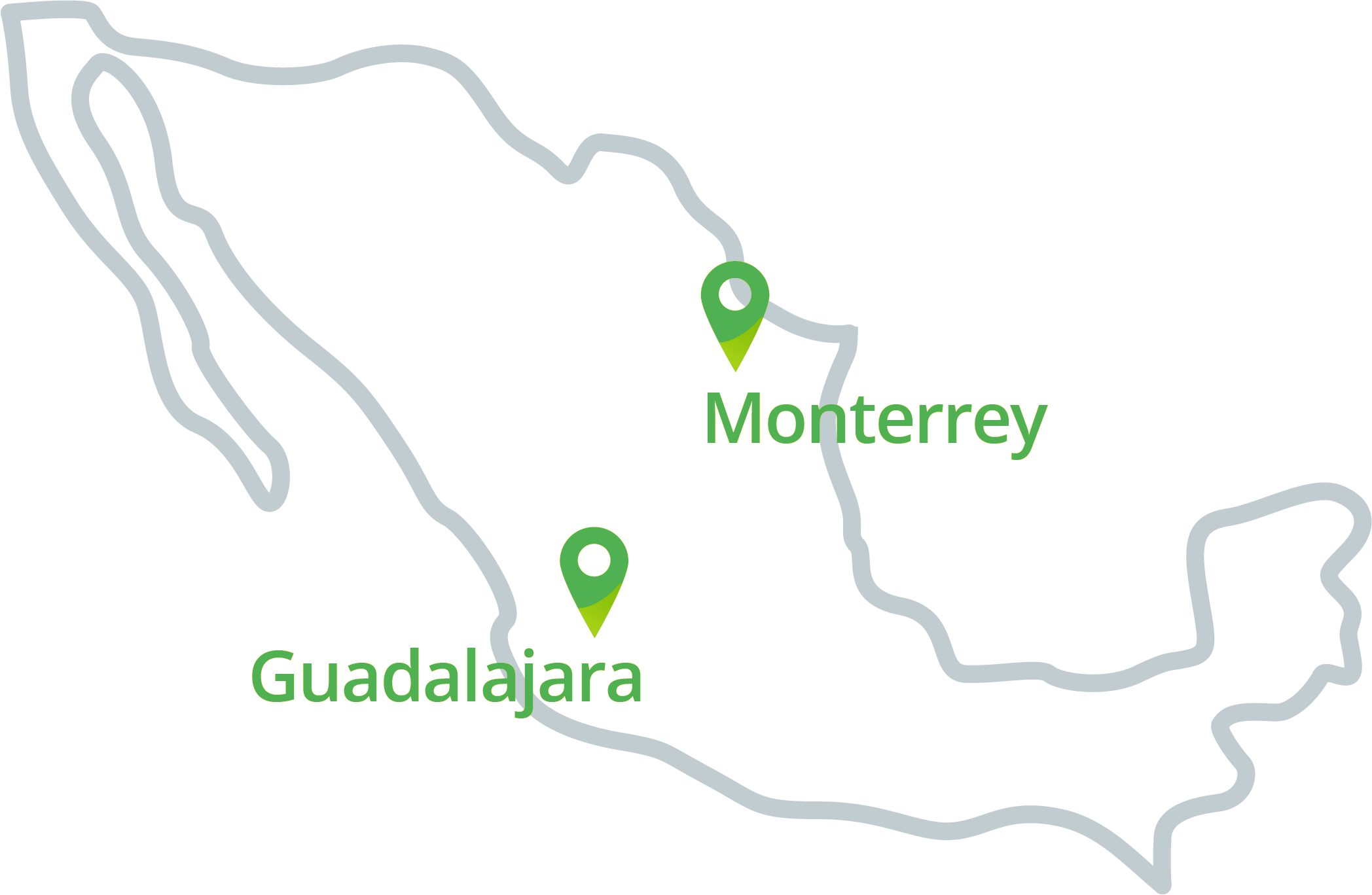
Monterrey
The Business Capital of Mexico and the IT HUB.
Fact sheet
Get a no-risk, custom scenario
Need to answer and RFP or build local presence for a global customer? Schedule a Meeting and learn more on North America Nearshore Scenarios built for B2B Tech Companies.
Start big or run a pilot operation in Mexico. The SUBaaS framework supports testing the region and customers response before fully committing to a large operation.
The best path possible into Mexico.