
Why global software companies build nearshore operations in Mexico
Real-time U.S. collaboration, practical travel, and specialized technology talent — without committing too early to a costly standalone structure.
$1.83T
Second largest economy in Latin America
#1
U.S. goods trading partner
1,954
Miles along the shared U.S.–Mexico border
USMCA partner · integrated North American supply chains · overlapping business hours · Sources: World Bank 2025 · U.S. Census Bureau May 2026 · U.S. CBP
The nearshore advantage
What makes Mexico a strong location for nearshore operations?
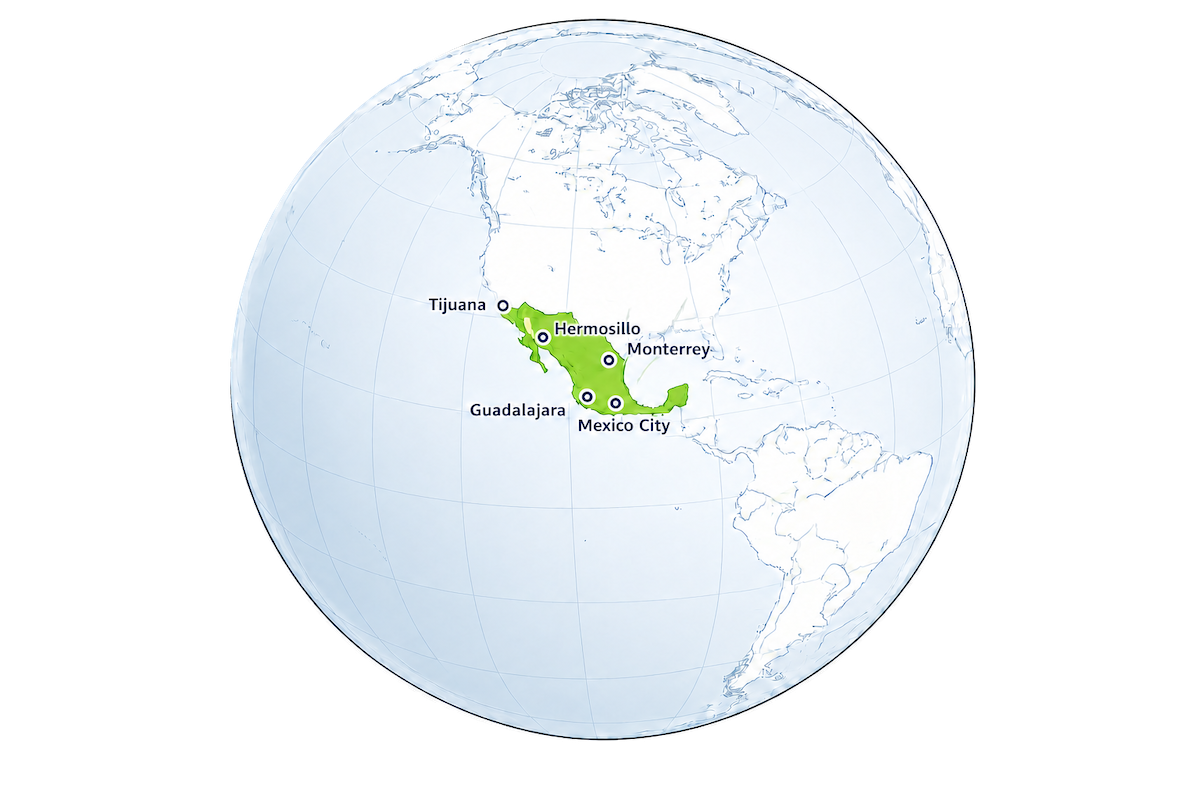
Mexico combines same-day collaboration across Central, Mountain, and Pacific time zones with direct U.S. travel and distinct talent markets in Monterrey, Guadalajara, Mexico City, Tijuana, and Hermosillo.
01 · Collaborate
Work in the same business day
Central, Mountain, and Pacific alignment supports live engineering work, customer conversations, and management oversight.
02 · Preserve
Protect the cost advantage
Launch on existing infrastructure instead of carrying the overhead of a premature standalone entity.
03 · Adapt
Launch, validate, then scale
Begin with a pilot or business unit. Add roles, cities, facilities, and functions when the operating case justifies them.
60 days — Typical path to a productive Mexico operation under the Everscale model.
01
Launch
Define the objective, role mix, and first team.
02
Run
Operate under your brand while Everscale runs the local backbone.
03
Scale
Add roles, locations, and business units without rebuilding the structure.
Regional strategy
Mexico or Brazil for a Latin America hub?
Start with the operating objective, not simply the largest available labor market.
Choose Mexico
When the priority is North American delivery and regional reach.
Best suited to same-day U.S. collaboration, practical travel, customer-facing operations, and phased expansion across Spanish-speaking Latin America.
Choose Brazil
When Brazil itself is the primary commercial market.
The region's largest individual market generally calls for a Portuguese-language, country-specific strategy and a more complex local operating approach.
Everscale planning rule: choose the country around the business objective, then choose the city around the work you need to build.
Five operating hubs
Choose the city around the work you need to build.
Each city brings a different mix of talent depth, hiring competition, cost, time zone alignment, and travel access.
ERP · SAP · Enterprise delivery
Monterrey
The USMCA border flagship for enterprise applications, senior consultants, and delivery center leadership.
Explore Monterrey →Full stack · Product · Cloud
Guadalajara
Mexico's strongest software engineering ecosystem for product, full stack, cloud, and digital delivery teams.
Explore Guadalajara →LATAM HQ · Largest talent pool
Mexico City
The country's broadest talent market and strongest anchor for a wider Latin America headquarters strategy.
Explore Mexico City →Support · Help desk · Back office
Tijuana
Pacific time capacity for customer operations and support teams aligned with the U.S. West Coast.
Explore Tijuana →Pilot teams · QA automation
Hermosillo
A cost-efficient launch market for focused pilots, QA automation, and operations that need to start lean.
Explore Hermosillo →Custom location strategy
How should companies choose a Mexico nearshore location?
Everscale compares role mix, salary pressure, language, time zones, travel, workplace needs, and expected scale before recruiting or facilities decisions begin.
After city selection, companies can compare the flexibility of Subsidiary as a Service with a planned build-operate-transfer model in Mexico.
Discuss a Custom Location →Location assessment inputs
Start the conversation
Choose the right Mexico city before you commit to the operating structure.
In 30 minutes, Everscale will review your role mix, team size, travel needs, and growth plan, then outline the best-fit cities and a realistic path to launch.
Become an expert in building a Mexico practice
In our Webcasts “Why Mexico as the preferred Nearshore destination” we focus on discovering the benefits of opening a subsidiary based in Mexico and how global players have taken advantage of Nearshoring for BPO, BPaaS, regional compliance, reducing risk through an unique legal framework and maximizing your start-up cost while accessing to a talented private network.
Common questions
Before selecting a Mexico location.
Mexico combines overlap with U.S. business hours, direct travel access, USMCA integration, and several distinct technology and business talent hubs. The right city still depends on role mix, seniority, language requirements, travel, and expected scale.
India remains well suited to large offshore operations and globally standardized work. Mexico is generally better suited to smaller, tightly integrated teams that collaborate live with U.S. managers, customers, and project teams. Many companies use both for different strategic purposes.
Mexico is usually the more direct choice for North American alignment and Spanish-speaking regional expansion. Brazil can be stronger when serving Brazil itself is the primary commercial objective.
Under Everscale's Subsidiary as a Service model, a productive operation can be launched in under 60 days once the team scope and role requirements are defined. A standalone build commonly takes longer because corporate, payroll, compliance, facilities, and recruiting work must be established in sequence.
Monterrey, Guadalajara, and Mexico City are the primary choices for engineering, enterprise applications, and larger delivery operations. Tijuana is better aligned with Pacific time support work, while Hermosillo is a focused option for cost-sensitive pilots and QA automation.