
The Nearshore COE is emerging as a more flexible model for global capability building after AI. Nearshore and offshore are complementary. India has long been the destination for large-scale, cost-efficient operations (global support, high volume services, and transactions). Nearshore (Mexico), by contrast, has positioned the Nearshore COE as a model built around customer-facing senior roles, real-time collaboration, and proximity to U.S. headquarters.
This dual structure has become fundamental to competitiveness in the IT Industry. It enables companies to tap into additional talent pools while integrating cost efficiency through labor arbitrage. In fact, a recent benchmark of 1,005 enterprise tech companies found that 81% operate a foreign center as part of their delivery model. And almost 36% have both nearshore and offshore. What is changing is not the use of foreign centers, but how they are designed.
But today, AI-driven productivity has forced companies back to the drawing board, much like the shift to SaaS, and before that, the dot-com revolution. Committing to a 300-person Global Capability Center on a three-year plan has become increasingly difficult to justify. Organizations simply do not know how many AI-assisted engineers will be required to deliver the same output, or how many fewer might be needed a year from now. AI has introduced volatility into workforce planning.
Recent data reinforces this ambiguity. A study of 6,000 executives found that nearly 90% saw no measurable impact from AI on employment or productivity, prompting economists to revive Robert Solow’s “productivity paradox.”
In this environment of uncertainty, three questions take center stage at the board level of tech companies:
- If small teams can deliver large outcomes due to AI, how many people should a foreign delivery center employ?
- If traditional blueprints no longer apply, how should modern centers be built to remain flexible and risk-mitigated? What is the minimum threshold for opening the foreign office?
- And strategically, where should these new Centers of Excellence be located?
Planning ahead has rarely been as complex as of today. But then again, reinvention has always been part of the technology industry’s DNA.
1. How Big Should the New CoE Be?
Historically, offshore centers meant building scale, with headcount as the primary driver of cost efficiency. Today, a highly capable architect with AI assistance can deliver the productivity of an entire team. In this environment, building large, fixed-capacity centers without visibility into AI’s future impact creates structural risk: premature scaling, constant costly restructuring, and inefficiencies.
The answer is smaller and scalable.
The Rise of the Micro-CoE
A recent benchmark study across 1,050 U.S.-headquartered, PE-backed enterprise software companies shows a clear structural difference between offshore and nearshore models. India locations average over 186 employees per site. Mexico locations average around 25. Companies are favoring small-team structures, launching micro-teams and scaling cautiously through nearshore models.
Micro CoEs are not new. Three years ago, industry analysts defined centers under 100 people as “cost-effective, capex-friendly solutions for companies exploring new digital initiatives”. Highlighting their agility, scalability, cost-efficiency, and versatility.
A 20–60 person AI-assisted Nearshore COE can deliver meaningful outcomes while maintaining flexibility because of its size. It can pivot and recalibrate its scale as AI evolves. The new CoE is measured by its force-multiplier effect, not by its volume of resources.
But size alone is not the only variable. Structure matters just as much.
2. How Should Modern CoEs Be Built?
If small teams are strategically preferred, the traditional expansion blueprint no longer holds.
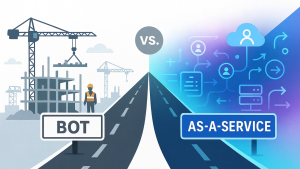
For years, companies relied on the Build-Operate-Transfer (BOT) model, engaging a local vendor to build a stand-alone operation, often requiring significant upfront commitment, fixed headcount targets, and multi-year lock-in.
But if a stand-alone operation struggles to be self-sustainable at lower headcount levels, adding the margin of a BOT vendor can eliminate its economic viability altogether.
Benchmark data shows that Mexico operations are heavily concentrated in small teams, with an average scale of 20 people, versus India’s 170.
But if do-it-yourself expansion required reaching certain headcount thresholds to be self-sustainable —60, 90, 120 employees — to achieve operational sustainability, how are tech companies building their nearshore operations today?
The modern Nearshore COE is no longer built around fixed scale, but around adaptability, modularity, and speed.
The As-a-Service Model for Nearshore
Modern organizations do not build sites, they use AWS. They do not commit to perpetual licenses, they use SaaS. It is the same when building a foreign operation.
Through as-a-service frameworks, companies leverage pre-existing economies of scale built by specialized providers. They can start small, pay for what they use, and scale up or down as needed. Heavy upfront CapEx is avoided. Shutdown exposure is minimized.
This model supports phased expansion. Companies can add business areas gradually and scale only when performance and certainty justify it.
Importantly, the as-a-service approach works not only for 60 or 120-person centers, but also for micro-teams of two to six professionals. By relying on one end-to-end accountable partner, organizations avoid the fragmentation that comes from stitching together multiple vendors (payroll platforms, recruiting firms, facilities providers, procurement intermediaries, market research firms, and so on). That fragmented approach often created accountability gaps, unexpected costs, delays, and ultimately, a bad foundation for long-term growth.
The new model mirrors cloud logic: scalable, modular, and flexible.
3. Where Should Modern CoEs Be Located?
For decades, companies optimized purely for cost, placing large delivery centers on geographies that maximized cost-efficiency. That model began shifting during the pandemic, when supply chain disruptions exposed the fragility of over-concentrated global footprints, so companies adjusted to regional hubs. Mexico now offers structural advantages for the Nearshore COE, including proximity, regional integration, and flexible operating models.
That regionalization trend has only accelerated. Trade tensions continue reshaping international business dynamics. Immigration policy shifts, including changes to H-1B cost structures, add further complexity to global workforce planning. India remains indispensable for global support services, but the expansion logic for new centers has changed.
Nearshore by definition is a regional hub. Unlike distant offshore centers, nearshore enables real-time collaboration with headquarters, tighter executive oversight, and travel times comparable to domestic flights. In an AI-driven environment where iteration cycles are faster and cross-functional coordination is constant, proximity becomes a must.
Mexico, the United States’ top trading partner, is embedded already in North America’s industrial ecosystem. The country has a long history offering soft-landing expansion frameworks for foreign investors, including the as-a-service model preferred by technology companies.
Organizations can launch flexible operations without committing to full local incorporation from day one. They can scale deliberately, adjust capacity as AI productivity evolves, and reduce exposure if priorities shift.
Even vendors historically focused on building operations in India have expanded their services to Mexico in response to their clients’ shifting demand.
Conclusion
Foreign operations will remain fundamental to the knowledge industry, supported by decades of infrastructure that enable talent to be accessed worldwide.
First, global operations reshaped cost structures for the IT industry. Then, the shift to Software as a Service transformed revenue models and eliminated the need for massive upfront infrastructure investments. Now AI is redefining productivity itself, allowing smaller teams to produce larger outputs and forcing companies to rethink once again how they design their operating models.
What once looked like commitment can quickly become rigidity. Large, all-encompassing Global Capability Centers built for scale are giving way to more deliberate, flexible structures. Capital discipline and risk mitigation are more than ever, central to strategy, and the future Nearshore COE is not defined by headcount, but by flexibility, resilience, and the ability to scale with AI.
At the same time, global trade patterns continue reinforcing regional integration, and with AI collaboration cycles accelerating, real time oversight is required. In this landscape, CoEs operating close to headquarters are not merely convenient; they are structurally aligned with how technology businesses now operate.
The mighty new CoE is not defined by headcount. It is structured for flexibility, and powered by the as-a-service model, leveraging local platforms that have built economies of scale over decades servicing companies from different industries, from manufacturing, healthcare, and enterprise tech.
In a world where technology, trade, and productivity evolve simultaneously, the organizations that thrive will not be those that build the largest infrastructure. They will be those that build the most resilient ones.
And increasingly, resilience looks like a small, flexible, AI-augmented nearshore operations.