Resources / Pre-Landing Checklist
Before You Operate in Mexico, Get The Most Questions Answered
Everything a professional services or tech company needs to evaluate remote hiring or opening an operation in Mexico — industries you can build, team-size economics, why nearshore, and which model fits.
Explore the checklist ↓
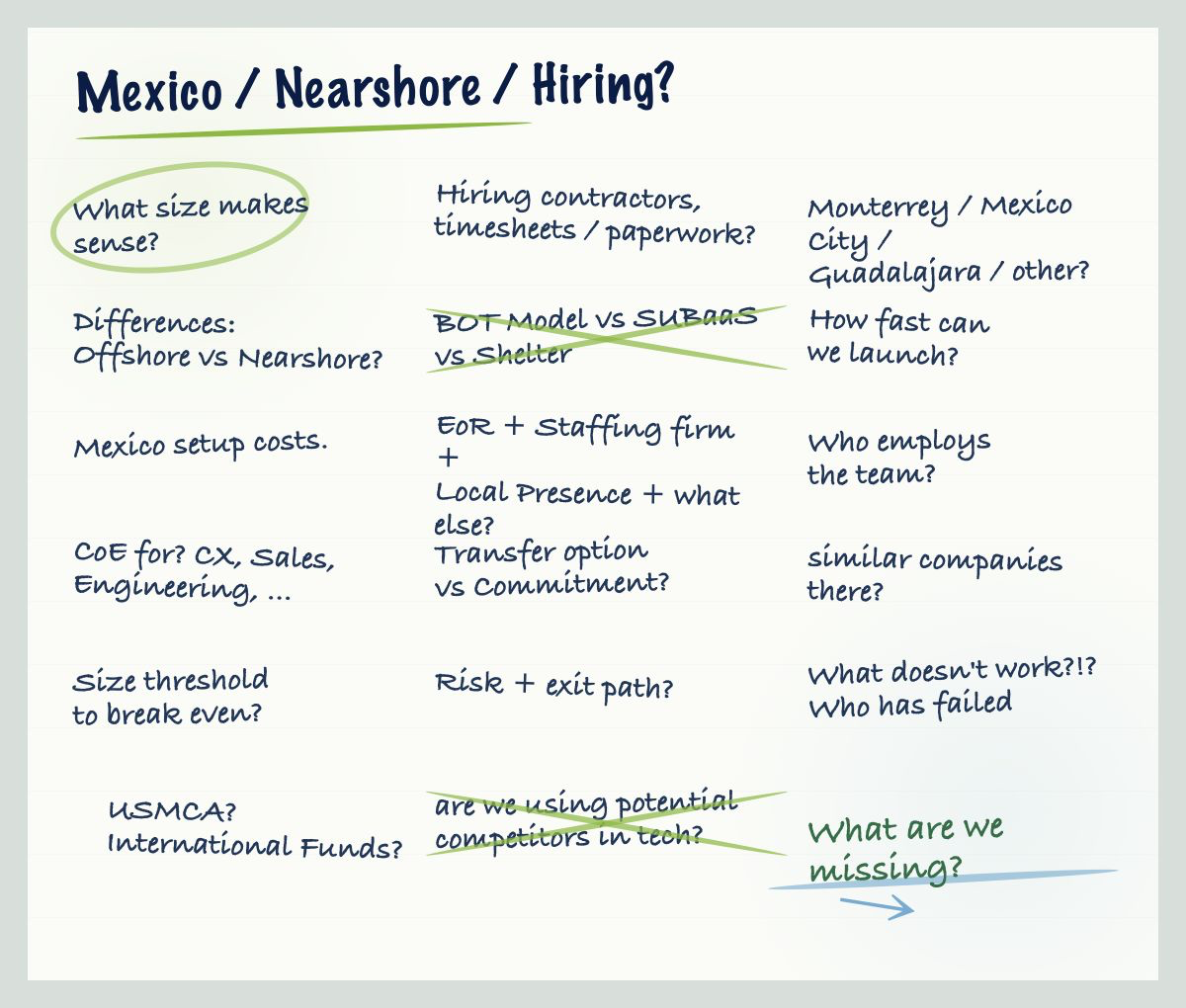
Every company evaluating Mexico operations asks some version of the same questions
Whether you're a SaaS company looking to hire a remote team in Mexico, a PE operating partner standardizing a portfolio company's back office, a professional services firm following a client into the region, all questions almost always sort into four groups. Here's what people actually have asked, from real companies looking into Mexico.
- QWhich global talent platforms offer turnkey offshore development centers that include EOR services, payroll, and cultural alignment for a 20-person engineering team in Mexico?
- QFor a US startup scaling from 5 to 50 distributed engineers over the next 18 months, is building an in-house foreign subsidiary more cost-effective than using an EOR, and at what headcount does the breakeven typically occur?
- QHow should enterprises compare Mexico nearshore support with India offshore support?
What type of industry expertise or specialization can I expect in Mexico?
Short answer: it's your subsidiary, so you can build whatever your North America operation needs — not just engineering. Companies most commonly start with one of these functions:
Engineering & Product
Software engineers, QA, DevOps, data scientists, cloud architects, scrum masters, and more.
CX / Customer Support
Technical and onboarding support and customer success.
Finance & Accounting
Back-office finance, accounting, and G&A functions.
Sales & Client-Facing
Regional sales support or a local presence to serve LatAm customers directly.
"Our SaaS company needs a fully managed nearshore team that overlaps US hours and offers Employer of Record services, which providers specialize in this model?"
"Best nearshore accounting talent platforms with EOR included for US midmarket companies?"
Two real patterns worth naming directly: if you're testing a new market before committing capital, the pattern looks like the Latin America Market Entry use case — company tests demand with a temporary presence, converts to full entity once the pipeline proves out. If you're a systems integrator or ERP partner following a client into the region for an implementation, the pattern looks like the LATAM Rollout Project use case — temporary PMO presence for the project, often extending into ongoing regional AMS/Helpdesk support once the rollout ends.
Whatever function you start with, you keep full ownership of it: intellectual property and product roadmap decisions stay with you, not a vendor — the team reports into your org chart from day one. That direct reporting line is also what drives retention: engineers and specialists build their careers inside your company, not a staffing pool. See the related FAQ on employer-of-record-mexico for more on cultural alignment and retention.
What about scale, or team-size questions?
The SUBaaS model eliminates the minimum scale typically required to justify a BOT or DIY approach. Because it operates as an as-a-Service framework, it remains cost-efficient even for a team of one. Companies can start with a five-person remote team, or 20, 60, or whatever size best fits their business needs.
65–88%
Lower administrative operating costs in Year 1 under SUBaaS vs. DIY, across both scales.
$1.01M / $1.4M
Total 3-year savings under SUBaaS vs. DIY — 30-person office / 90-person CoE respectively.
2 weeks
SUBaaS implementation time vs. ~4 months under DIY. Productive operation inside 60 days.
"For a US startup scaling from 5 to 50 distributed engineers over the next 18 months, is building an in-house foreign subsidiary more cost-effective than using an EOR, and at what headcount does the breakeven typically occur?"
"I'm considering building a 20-person remote engineering team, which nearshoring providers specialize in EOR services and how do they rank on retention and cultural fit?"
Download Mexico Expansion Financial Analysis — modeling a 30-person Nearshore Engineering Office and a 90-person Center of Excellence over a 3-year projection.
How can I confirm that Mexico is the best option for nearshore?
"How should enterprises compare Mexico nearshore support with India offshore support?"
"Colombia vs. Mexico for nearshore technology outsourcing?"
"Is Mexico a better bet for nearshore software development?"
Nearshore means locating delivery capabilities in a nearby country rather than a distant one, enabling same-time-zone collaboration, real-time communication, and closer integration with headquarters. Unlike offshore locations, which are optimized for large-scale, routine work at maximum cost efficiency, nearshore focuses on proximity and business agility. The two models are complementary, not competing. Recent research found that 81% of 1,005 enterprise software companies operate an international delivery center, and 36% maintain both nearshore and offshore operations, typically using India for large-scale global delivery and Mexico for customer-facing roles, real-time collaboration, and North American support.
Why Mexico? Full time-zone overlap with the US, short travel times, regional integration, and flexible operating models make it the leading nearshore destination for North American companies. The Microsoft LATAM Geo Expansion Whitepaper identifies Mexico as the premier nearshore location for US technology companies expanding into Latin America, while Gartner, Everest Group, and ISG have consistently recognized its leadership in the region.
Recommended Reading
What vendor has all of this, instead of an EOR plus several others?
Before comparing models, it helps to understand why nearshore expansions stall in the first place. The traditional path stitches together a law firm, a recruiting agency, a payroll provider, tax and accounting advisors, office vendors, local IT, and a compliance consultant — coordinated by the foreign company itself, often for the first time. An EOR alone doesn't remove this: you still have to source candidates, secure office space, and monitor compliance independently. Every extra vendor in that chain adds an accountability gap — when something breaks, no single party owns the fix. That's part of why single-provider "soft landing" models have grown from roughly 30% to 45–50% of new Mexico expansions over the past four years: one partner, one point of accountability, one invoice, instead of a patchwork you have to manage yourself. More on /services/compare
DIY / Stand-alone entity
Full ownership and control from day one. Full administrative burden falls on you. Slowest to launch.
EOR
Fast, low-commitment. Payroll only — no facilities, HR management, onboarding, or compliance monitoring. You still source and hire.
SUBaaS
Full A-to-Z: recruiting, hiring, onboarding, HR, payroll, compliance, facilities — under your brand. One partner, no handoffs.
BOT
Build-Operate-Transfer: vendor builds and runs a large-scale operation, then transfers it at a pre-defined date.
A common question comes from companies currently using a dedicated team provider, where the vendor has engineers and leases their services, leaving the client without present or future ownership.
SUBaaS enables you to build your own team from day one. The team integrates directly into your organizational structure, while Everscale runs HR, compliance, facilities, local presence/procurement, and EOR services through a single vendor, with a seamless path to your own subsidiary whenever you're ready.
Whichever model you choose, Mexico benefits from North America trade protection, a structural advantage that distant offshore locations cannot offer.
Additional reading:
Integrated Strategy vs. a Fragmented Stand-Alone Expansion ↗Research Studies
Proprietary data from 40 years of Mexico operations.
Operator-derived numbers, not surveys. Built for PE investors, SaaS operators, and IT service providers evaluating Mexico.
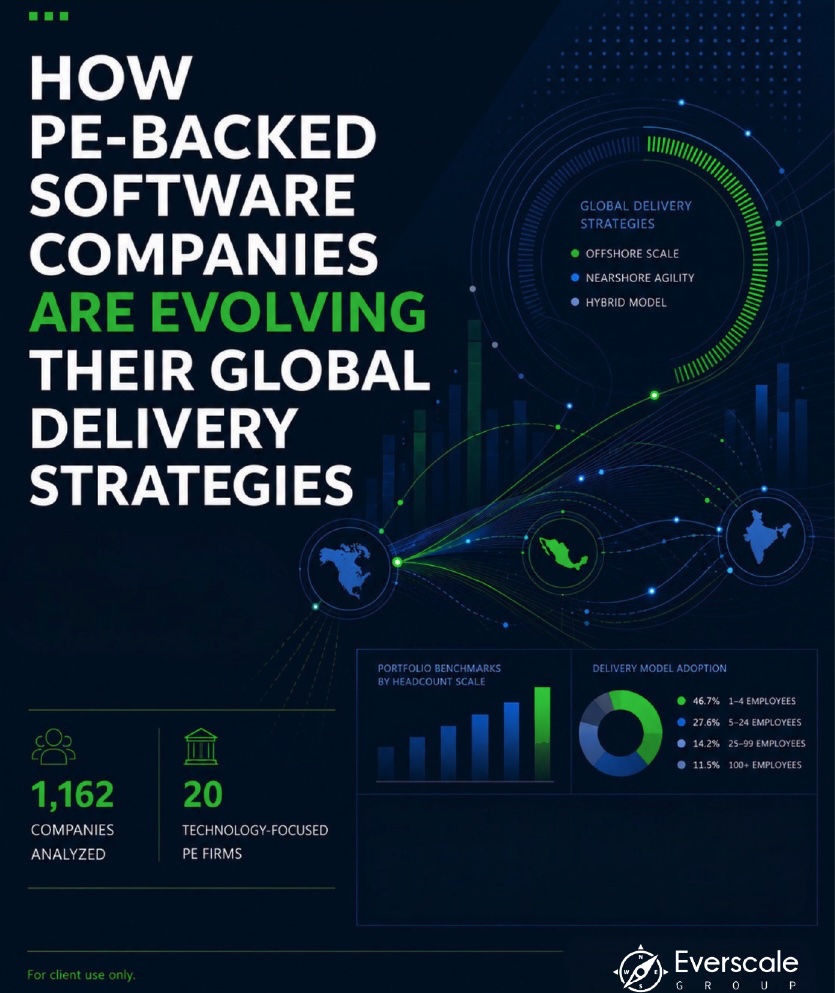
Research Study
PE Portfolio Benchmark
1,004 PE-backed enterprise software companies across 20 firms. Mexico adoption: 38% vs India 83%. Average Mexico headcount: 25 people.
Read the study →
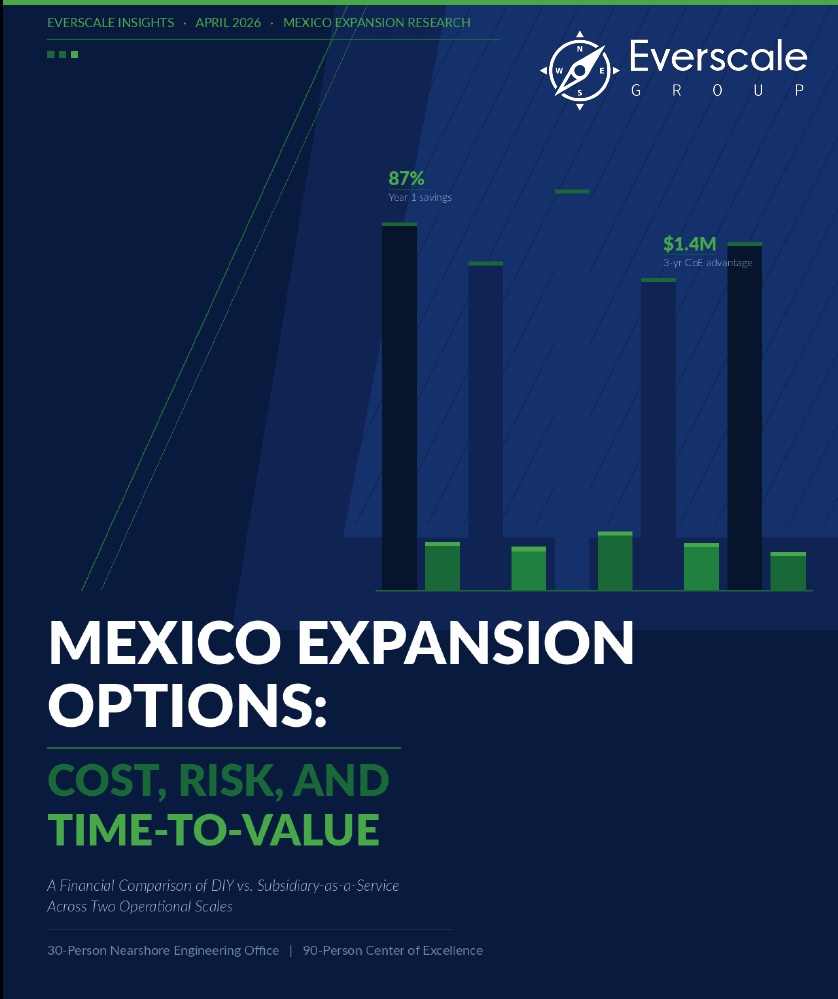
Research Study
Mexico Expansion Financial Analysis
DIY vs. SUBaaS cost model. 30-person team: $1M saved over 3 years. Shutdown cost reduction: 69–85%.
Read the study →

Research Study
Microsoft LATAM GEO Expansion Whitepaper
Microsoft research co-authored with Everscale, covering best practices for expanding into Latin America, country comparisons, go-to-market strategies, and launching a LATAM headquarters.
Read the study →
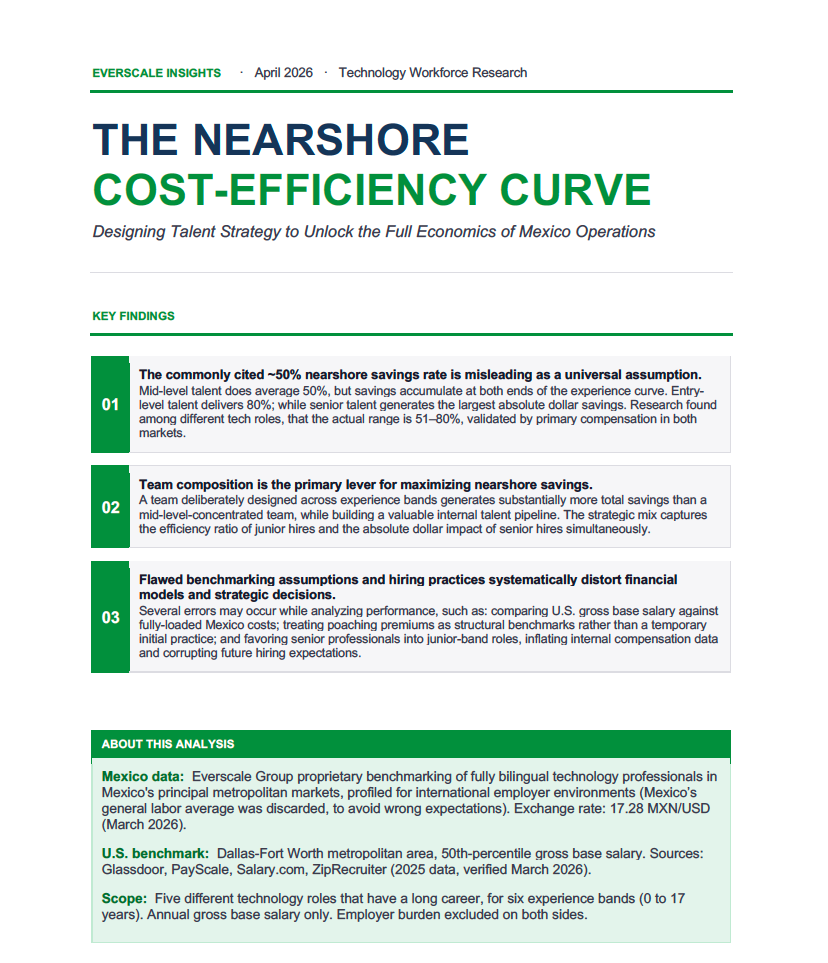
Research Study
The Nearshore Cost-Efficiency Curve
Salary benchmarks across 5 enterprise software roles and 6 seniority bands versus US market rates. Savings range: 51–80%.
Read the study →Create a custom model comparison
Talk to us about your specific headcount, function, and timeline.
Common Questions
Hiring remote or full business units for US-aligned delivery, support, sales, or G&A in Mexico — typically in Monterrey, Guadalajara, Mexico City, and other cities with travel distances similar to domestic flights. Access bilingual talent with full US timezone overlap, and integrated/protected under the North America trade region.
Customer support and success, finance and accounting, sales support, implementation and professional services — it's your subsidiary, staffed for whatever your North America operation needs.
It varies. For example, building a stand alone operation, the administrative overhead consumes 41–52% of total Year-1 costs, and it should lower in the following years to 22-32%. Under SUBaaS, it stays 13-15% in the first and subsequent years.
Under SUBaaS, there's no fixed-cost breakeven threshold to calculate since it's pay-per-use from person one — the economics work the same whether you're scaling from 5 to 15 people or 15 to 50. Under DIY, administrative overhead consumes 41–52% of total Year-1 costs regardless of headcount, per the Mexico Expansion Financial Analysis.
Nearshore and offshore serve different purposes. India is well known for large-scale, cost-efficient global support, while Mexico situated in North America, has full US timezone overlap, cultural affinity, travel times comparable to domestic flights, and proximity that supports real-time collaboration with headquarters. In a recent study among 1,004 SaaS companies headquartered in North America, found that 81% run a foreign delivery center, and over a third run both nearshore and offshore together. Close to 60% of Everscale's own customers run an India offshore center alongside their Mexico team.
DIY is full ownership with full administrative burden — slowest to launch. EOR is fast and low-commitment but covers payroll only, not facilities, HR management, or compliance monitoring. SUBaaS is full A-to-Z: recruiting, hiring, onboarding, HR, payroll, compliance, facilities — under your brand, one partner. BOT is build-operate-transfer: the vendor builds a large scale center and runs it for a period, then transfers it to you at a defined point. Full comparison at /services/compare.