NEARSHORE OPERATIONS · ONE PARTNER
One partner for recruiting, EOR, local presence and compliance in Mexico
Most companies entering Mexico end up managing four to eight separate firms across many functions: a recruiter, an EOR, an office provider, compliance advisors, local consultants. One partner can run all of it under one contract, with one accountable contact and one invoice.
BACKED BY 40 YEARS IN MEXICO · NATIONWIDE PRESENCE
MANAGING SEVERAL VENDORS IN MEXICO?
Get a vendor consolidation plan for your Mexico operation: your current vendor map, what one partner covers, and a cost comparison.
Request a Free Assessment →No commitment required
Key takeaways
When your team is not yet large enough to justify your own entity, the usual workaround is an Employer of Record platform plus other vendors, which leaves you managing four to eight separate firms across many functions, coordinated by you, often new to the country. An integrated partner reduces that to one contract, one accountable contact and one invoice.
For enterprise software, SaaS and IT services companies, the integrated option in Mexico is the as-a-Service model: recruiting, employment, payroll, compliance, logistics and facilities from a single provider, each used only when needed.
Opening your own entity means a substantial upfront investment, a long-term commitment to a team size you may not need yet, and 6+ months to reach a productive operation. An integrated partner gets you there in 3–6 weeks, without that commitment.
Local presence means more than an office: people on the ground for equipment, in-person HR matters and team gatherings, which an EOR platform does not provide.
One end-to-end partner provides not only on-call experts across different areas, but also a 360-degree view of the operation when you make crucial decisions.
Who offers an integrated solution in Mexico?
Mexico has a long history of soft-landing providers that bring recruiting, employment, payroll, HR compliance and facilities together under one contract. For prospective clients, that means several choices, each specialized by industry.
| Industry | Integrated provider |
|---|---|
| Enterprise software, SaaS, IT services | Everscale Group — Subsidiary-as-a-Service built for technology companies, nationwide. |
| Manufacturing | Tetakawi — pioneer of the shelter model for manufacturing in Mexico. |
| Call centers, back office, BPO | Intugo — integrated operations for call centers, BPO and back-office teams. |
DIRECT ANSWER
For software and IT services companies, the integrated option in Mexico is the Subsidiary-as-a-Service model, also known as GCC-as-a-Service: one provider handles recruiting, employment, payroll, HR, compliance and office space, while you keep your team, your brand and your standards. One accountable contact. One invoice. No finger-pointing between vendors.
Looking for a vendor that bundles EOR, staffing and local presence in Mexico?
An EOR-plus-staffing bundle covers two functions: finding people and employing them. A Mexico operation also needs logistics, shared offices or dedicated facilities, labor market research and advisory, on-the-ground support when incidents happen, and more, which usually means several more firms. Everscale covers all of them under one contract, as one partner.
Vendor sprawl vs one partner: recruiting, EOR, payroll, HR compliance and local presence under one roof
When opening your own entity is not an option yet, the usual workaround is an EOR platform plus a set of separate vendors: a recruiter, an office provider, compliance advisors, local consultants. That typically means coordinating four to eight firms across ten or more functions.
An integrated partner reduces that to one contract, one accountable contact and one invoice. It sources and vets your team, employs them under Mexican law, runs payroll, handles compliance, and equips and houses them, with experts on call by area and on-the-ground support when incidents happen. It works the same whether the team is in engineering, customer support, customer success, sales support or back office.
| Function | EOR workaround: who does it | One partner: what is included |
|---|---|---|
| Recruiting | Recruitment or staffing agency | Sourcing, screening and talent vetting, technical assessment, bilingual candidates, offer management, local salary benchmarking |
| Employment | EOR platform | Employment under Mexican law, contracts, onboarding and offboarding |
| Payroll and benefits | EOR platform | Calculation, statutory contributions, profit sharing, benefits (insurance, savings funds, statutory benefits) |
| Talent strategy | Compensation research firms | Compensation design by location and niche, talent pipeline, retention strategy |
| Culture and local advisory | Consulting firms by area | Cultural alignment, go-to-market strategy, compliance and other local advisors by area, on call, with US time zone overlap |
| HR compliance and regulations | Compliance consultants | Labor law, policy, documentation, audits, international banking, cross-border structure |
| Facilities management | Office or coworking vendors | Office space and equipment, nationwide |
| Local networking | Relocation advisors, brokers and others | Relocation assistance, university connections for internships and programs, tech industry network |
| Procurement and logistics | Hardware and equipment vendors, logistics providers | Hardware and equipment purchasing, events, office and local expenses, travel booking, logistics coordination |
| Location selection | On you | Advised and executed |
| Local presence | Nobody on the ground | People on the ground for key events and for work that has to happen in person, such as certain terminations |
| Governance | One contact and one invoice per firm | One accountable contact, one invoice, one version of what is happening |
| Firms you coordinate | 4–8 | 1 |
Some firms cover more than one function, and not every service is needed at the same time or from the start, which is why the count usually lands between four and eight rather than one per function. Either way, each firm is a separate contract, a separate invoice, a separate point of contact and a separate opinion, unaware of the decisions being made in other areas. It is a costly path on a steep local learning curve.
The result is not just slow. It is a structure with accountability gaps. When something goes wrong, every vendor can point at another. Nobody owns the outcome. With one partner, you keep the team, the brand, the standards and the performance expectations, and the provider carries the full local operating risk on its legal entity.
End-to-end, not a bundle of separate vendors
One contract, one accountable contact, one invoice: that is what “integrated” means, and it is the thing a referral list cannot reproduce. A payroll platform that hands you a list of recruiters, office providers and compliance advisors has not integrated anything. It has introduced you to the vendors you were trying to avoid, without standing behind any of them.
UNDERSTANDING THE GAPS
Why an EOR platform on its own does not solve vendor sprawl
Companies often reach for an Employer of Record expecting it to collapse all of this into one relationship. It does not.
An EOR is a self-service platform built to serve roughly 160 countries at once. It employs your people and runs payroll. You still need a recruitment agency to find the team, an office provider to house them, salary and market data to price the roles, and a compliance consultant to check the setup.
An EOR removes one vendor from the list. It does not remove the list.
An EOR is the right tool for a short test, a single hire, or a market you are not sure about. It is the wrong tool for an operation that is becoming part of how the business runs, which is exactly when vendor sprawl starts to cost real money.
Local advisory becomes a global queue
A platform serving dozens of countries cannot staff a local expert for every market. Support is centralized and ticketed by design. When a Mexican labor-law question comes up, the answer arrives from outside the country on a one-to-two-business-day ticket. So you hire a local compliance consultant anyway. The vendor stays on the list.
"Everything you need" means payroll
An EOR processes payroll. Recruiting, offices, market data, compliance and planning are separate vendors you hire and coordinate yourself, often from a referral list the platform does not stand behind. When something breaks, the vendors point at each other and the only accountable party is you. The accountability gap is not closed, it is relabeled.
You get an employment record, not a team
Pay someone remotely with no local colleagues, no office and no culture around them, and you have hired a free agent who may already be weighing other offers. Fixing that means a recruiter, a local HR presence and somewhere for people to go. Three more relationships.
Nobody is choosing the city or building the pipeline
An EOR will not pick where you build, construct a talent pipeline or design a retention plan. Those decisions determine whether the operation works, and they surface later as expensive problems. They stay with you, or with another advisor.
Why the workaround exists, and why one partner keeps overhead low
Companies use the EOR workaround because opening their own entity means a large upfront investment and a long-term commitment to a team size they cannot yet confirm. The biggest part of that cost is not the team. It is the administrative structure behind it: HR, finance, recruiting, IT, legal, compliance, facilities and advisory. Salary savings are only half the model. The operating model decides how much of that saving survives once the structure is paid for.
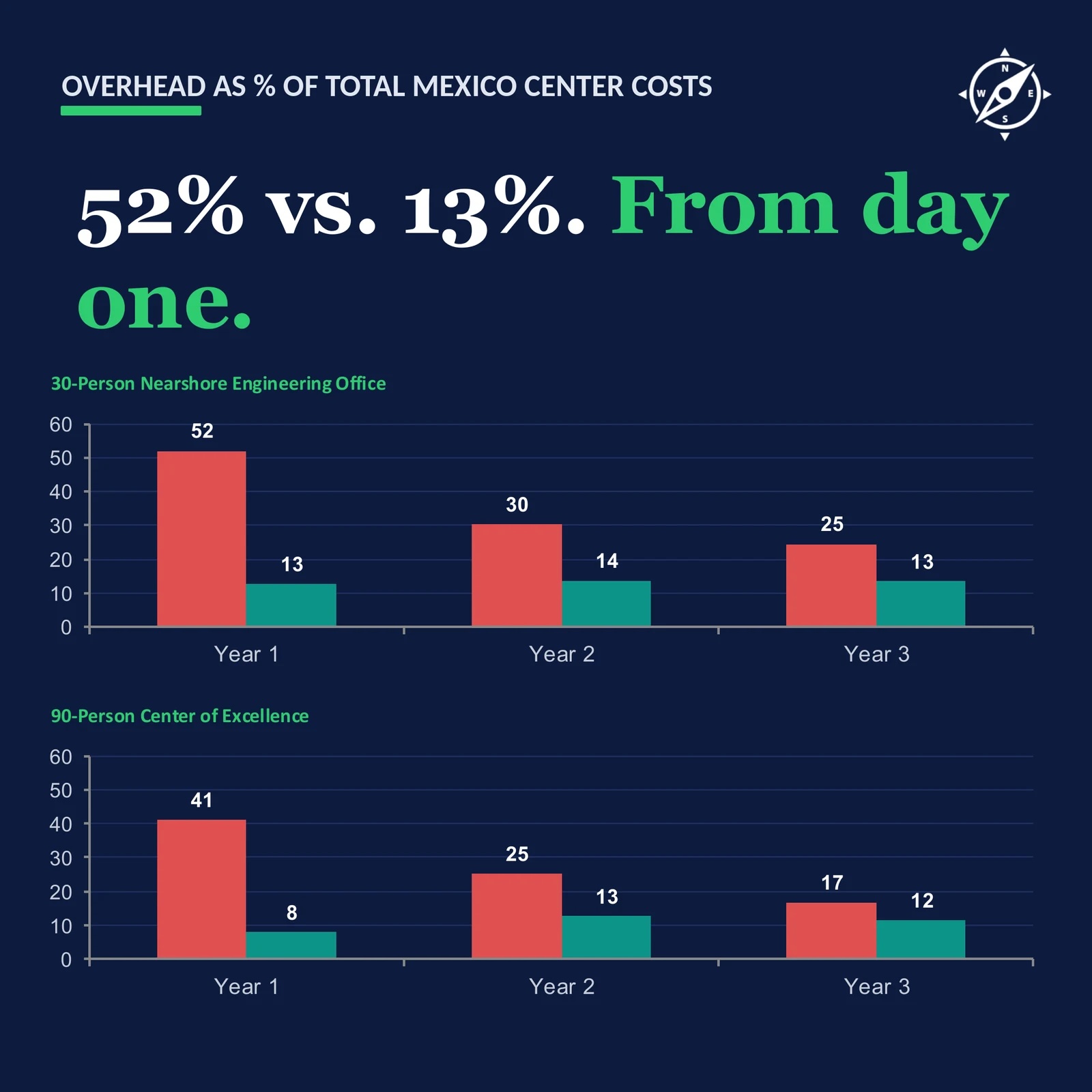
52% vs 13%, from day one.
In a 30-person office, a stand-alone entity spends 52% of its Year 1 cost on administrative structure. That structure costs roughly the same whether it supports 30 people or 90, so it does not shrink with the team, and the gap does not close: by Year 3 the stand-alone entity is still at 25%. Under the as-a-Service model, overhead stays between 8% and 14% from the first year through the third, at both team sizes.
One partner keeps overhead low from the start. The structure already exists and is shared, so you pay for the share your team uses, from a team of two upward, without building an entity of your own.
| 30-person nearshore office | Stand-alone entity | One partner (Subsidiary-as-a-Service) |
|---|---|---|
| Overhead ratio, Year 1 | 52.0% | 12.6% |
| Overhead ratio, Year 3 | 24.5% | 13.4% |
| Year 1 operating cost | $411,404 | $54,601 (87% lower) |
| Cost if you exit after Year 1 | $512,086 | $85,544 (83% lower) |
| Time to a productive operation | 6+ months | 3–6 weeks |
Three-year cumulative difference: about $1.0M. Engineering salaries excluded from both models by design. All figures USD, fully loaded.
Why more companies are choosing an all-in-one Mexico partner
30% → 45–50%
Share of companies using local specialists rather than doing it themselves, over four years
35% vs 76%
Mexico versus India adoption across 1,162 enterprise software companies backed by 20 private equity firms
26 vs 192
Average employees in a Mexico operation versus an India operation, in the same study
Mexico operations are small by design. A 26-person operation cannot carry the overhead of ten vendor relationships and a full local administrative structure, which is why the integrated model and the small-operation pattern grew together.
How an integrated partner works, step by step
Define
The capability (engineering, customer support, customer success, sales support or back office), the roles, the standards, the timeline. You set objectives; we map them to a Mexico operating plan covering site selection, HR localization and talent optimization, according to your short- and long-term goals.
Build
Specialized recruiting runs against your requirements. Employment, payroll, facilities and compliance are already in place, so there is no vendor assembly. Our procurement team handles purchasing and setup.
Operate
One contact, one invoice, monthly reporting. Your team works to your standards, under your brand, on our infrastructure, with assigned experts by area.
Decide
Stay on the model, scale it, or move to your own entity when the operation justifies it.
Productive in 3–6 weeks, against 6+ months for a stand-alone entity.
Ready to replace your Mexico vendors with one partner?
Tell us which firms you work with in Mexico today and what your team does. We'll show you what one partner would cover, how the move would work, and what it would cost.
Cost, overhead ratio and timeline figures: Mexico Expansion Variables: Cost, Overhead Ratio, Risk, and Time-to-Value, Everscale Group, April 2026. Models a 30-person nearshore engineering office and a 90-person Center of Excellence over three fiscal years, comparing a stand-alone entity against Subsidiary-as-a-Service. Engineering salaries excluded by design. All figures USD, fully loaded, including employer-side benefits and taxes. Adoption and headcount figures: 1,162 PE-Backed Enterprise Software Companies Benchmark Study, Everscale Group, June 2026. Everscale Group is part of the Tetakawi group. Last updated: November 2026.